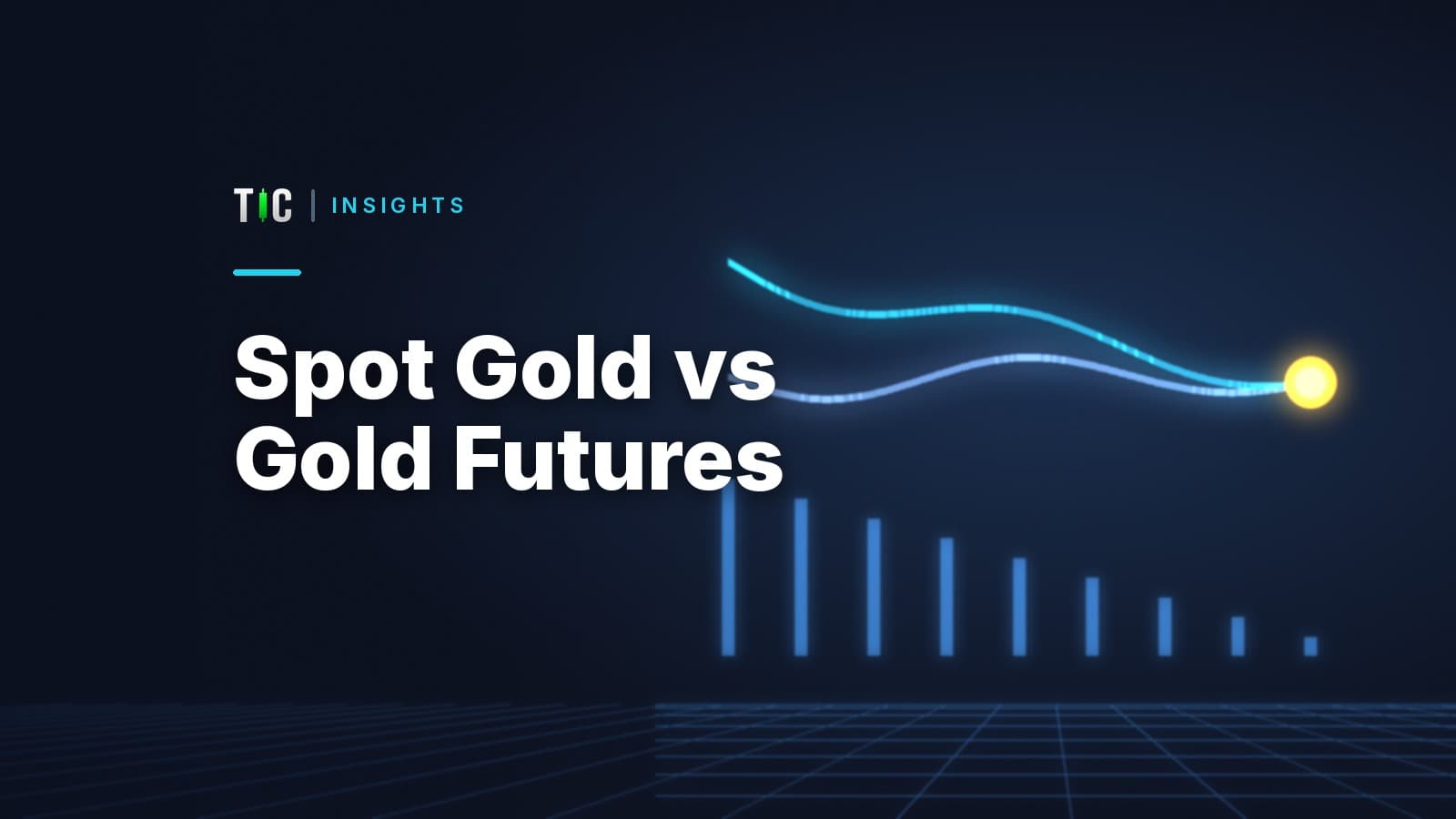
Both prices track the same metal, so they move together almost all the time. The difference between spot gold and gold futures lies in three things: when the trade settles, who stands behind it, and what it costs to hold.
What is the difference between spot gold and gold futures?
The shortest answer is time. A spot price is for gold now. A futures price is for gold on a later date, so it includes the cost of waiting: mainly the interest you could earn on the cash instead, plus storage and insurance, minus any income from lending the gold out.
| Feature | Spot gold (OTC) | Gold futures (COMEX GC) | Retail XAU/USD CFD |
|---|---|---|---|
| Where it trades | Over the counter between dealers | On a central exchange | With your broker |
| Contract size | Negotiated | 100 troy ounces | Set by the broker |
| Settlement | Near-immediate | A set delivery month | No delivery; rolled or closed |
| Price reference | Dealer quotes; LBMA Gold Price benchmark | Exchange trading, minimum tick $0.10 per ounce | Broker quote, often based on spot |
| Cost of holding | Financing on any credit used | Built into the futures price | Overnight financing (swap) charged by the broker |
The retail column matters because many traders believe they are trading "spot gold" on a CFD platform. They are trading a broker's contract that references gold, and its terms, including lot size and overnight charges, are set by that broker. See our guide to pips and lots for why you should always check the contract sheet.
Why is the futures price usually higher than spot?
Because of the cost of carry. Holding gold for three months ties up cash that could earn interest, and the futures price builds that cost in. When futures trade above spot, the market is said to be in contango, which is the normal state for gold. The gap between the two prices is called the basis.
Assume, purely for illustration, that spot gold is $4,000 per ounce and short-term interest rates are 4% a year. A rough carry estimate for a contract three months away is:
- $4,000 × 4% × 3/12 = $40 per ounce
- Estimated futures price ≈ $4,040
On one COMEX contract of 100 ounces, that $40 basis is worth $4,000. Each $0.10 tick moves the contract by $10, so a $1 move in gold changes the contract's value by $100, and the full contract represents about $404,000 of gold. Real basis levels also reflect gold lease rates, storage and market conditions, so treat this as a sketch, not a pricing model. Occasionally, when physical gold is tight, futures can even trade below spot, a state called backwardation.
What happens when a gold future expires?
The futures price converges towards spot. As delivery approaches, the cost of waiting shrinks towards zero, and anyone can buy the physical metal and deliver against the contract, or the reverse, if the gap is too large. CME Group's contract specifications state that trading in the gold contract ends on the third last business day of the delivery month and that delivered gold must assay at 995 fineness or better.
Most futures traders never take delivery. They close or roll their position into a later month before expiry, and each roll locks in the basis between the two months.
Which price should you use?
- To value physical gold or follow the news, use spot. Our guide on how to invest in gold across the GCC explains how retail prices sit on top of it.
- To trade with a defined exchange contract, futures are transparent, centrally cleared and standardised, but large: one 100 ounce contract is a big position for most individuals.
- On a CFD, remember that the overnight financing you pay plays a similar role to the futures basis. Holding a position for weeks has a cost whichever route you take.
Leverage is the common risk in futures and CFDs alike. Exchanges and brokers ask for margin that is a fraction of the contract's value, so a modest move against you can take a large share of your deposit. Our explainer on what leverage really does shows the arithmetic.
Where does TIC fit in?
Level 7 of the free Trading Academy in the TIC app, Advanced Markets, opens with a complete guide to gold, including what drives the price. Whatever product you use, size the position by what you can afford to lose if the price moves against you, not by the contract's headline value.
Sources
- CME Group, Gold futures contract specifications and COMEX Rulebook Chapter 113: Gold Futures
- LBMA, LBMA Gold Price
The prices and interest rate in this article are hypothetical and used only to illustrate the calculation.
Trading carries high risk and you may lose your capital. Past performance does not guarantee future results. Educational only, not investment advice.
Verify any trader's results in 10 minutes
Seven checks that reveal whether a track record is real: third-party verification, maximum drawdown, trade count, and the martingale warning signs. Use it on anyone — including on us.
We'll send the checklist plus occasional TIC insights. We never share your email, and you can unsubscribe any time.